
Explore Our Services
Strategic Consulting
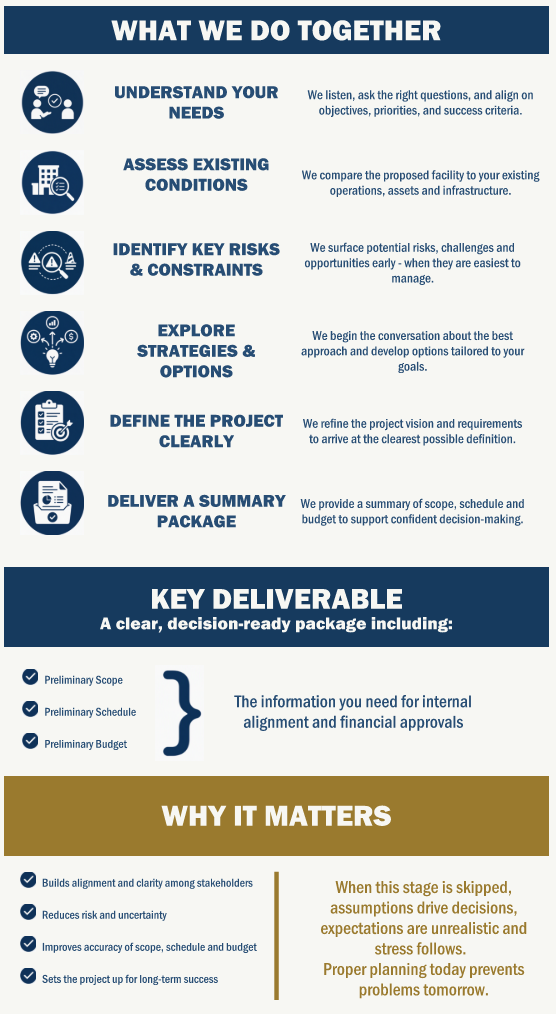
Start with an experienced project advocate on your side of the table.
The results will follow.
The most important decisions in any facility project are made before the first dollar is spent or the first wall is built. Budgets and schedules are essential, but the right strategy and project team are what drive successful outcomes. Early missteps can lead to costly consequences that are difficult to reverse.
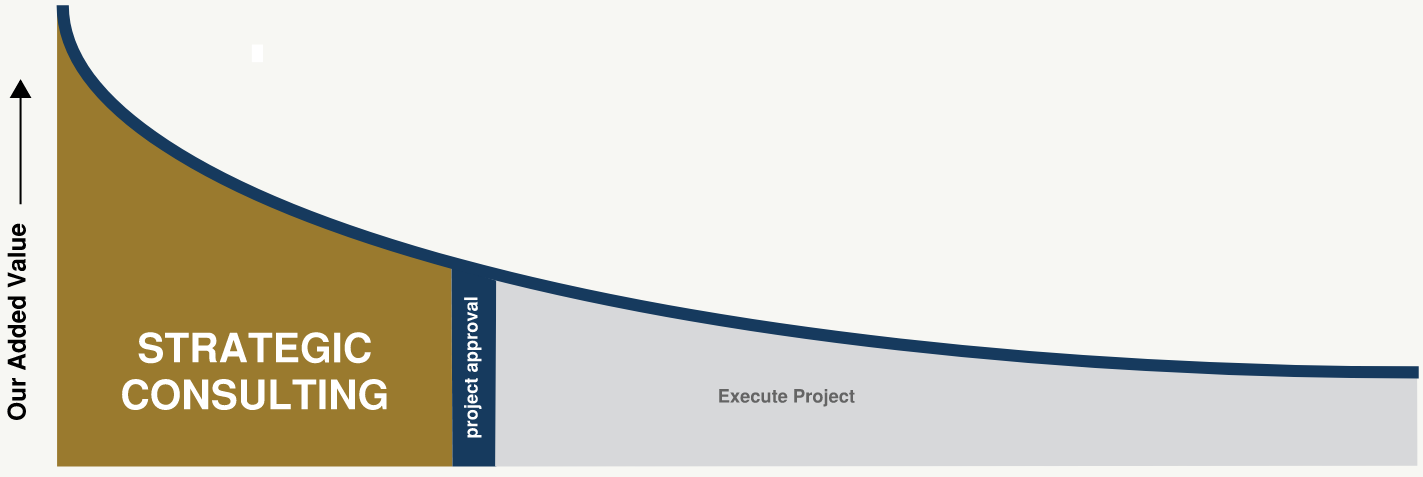
In our experience, over 80% of total project savings is delivered during this stage of your project.
-
Assess current operations, inventory profiles, growth projections, and facility requirements.
Conduct stakeholder interviews and facility benchmarking to understand business needs, workflows, and operational constraints.
Develop estimated building footprint requirements, including storage, docks, office areas, value-added services, and support functions.
Evaluate alternative building configurations based on clear heights, utilization targets, and operational assumptions.
-
Establish project objectives, business drivers, timeline, and implementation strategy.
Assess existing facility conditions, deferred maintenance requirements, and baseline operating costs.
Identify and evaluate viable alternatives, including expansion, reconfiguration, relocation, build-to-suit, or renovation options.
Develop comparative budgets, schedules, and high-level implementation plans for each alternative.
-
Define facility planning requirements, operational goals, and equipment interfaces.
Support industrial engineering, space planning, and conceptual layout development.
Develop master project budgets, implementation schedules, and phasing strategies.
Align future design, procurement, equipment, and construction activities with business objectives.
Strategic Consulting Scope Typically Includes:

The right project team can be the difference between success and disappointment.
Our philosophy is simple: great projects are built through collaboration, not conflict. We foster an environment where every stakeholder is aligned, treated fairly, and focused on a shared goal. When developers, consultants, contractors, and vendors work together with mutual trust and accountability, exceptional outcomes follow.
Over the years, we have built strong relationships with leading developers, general contractors, architects, engineers, and specialty consultants throughout the industry.
We leverage these trusted partnerships to assemble the right team for each project, creating value for our clients and helping ensure successful project delivery from concept through completion.
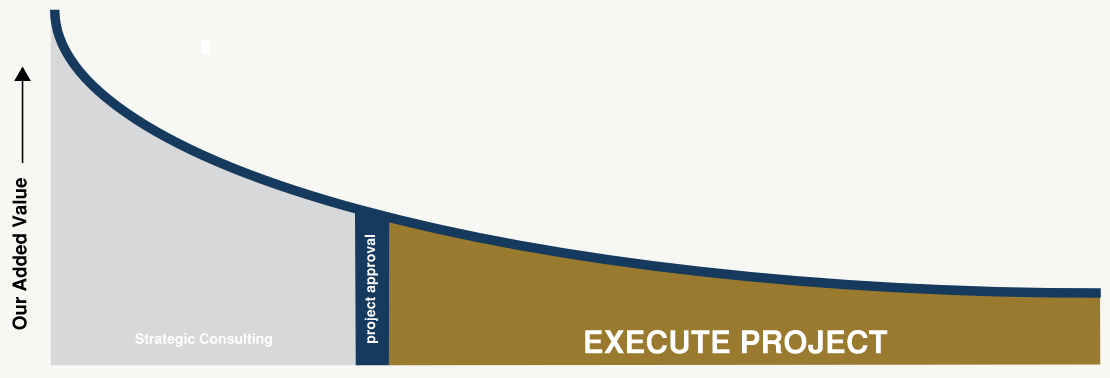
Project Execution
-
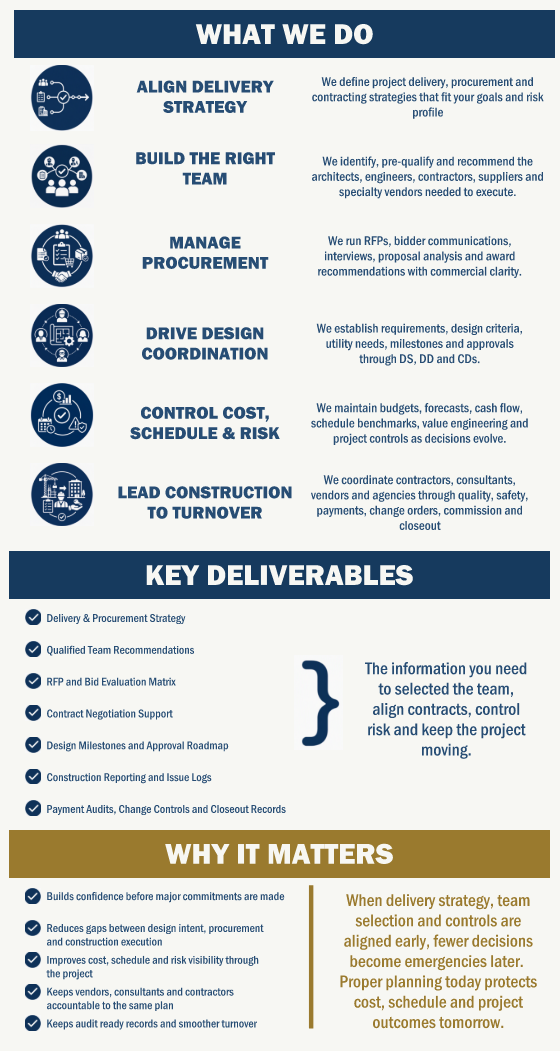
Define project delivery, procurement, and contracting strategies aligned with project goals and risk profile.
Identify, prequalify, and recommend architects, engineers, consultants, contractors, suppliers, and specialty vendors.
Conduct market analysis, contractor due diligence, and procurement planning.
Prepare and manage RFPs, bidder communications, evaluations, and interviews.
Analyze proposals and provide recommendations based on qualifications, cost, schedule, and risk.
Support contract negotiations and ensure commercial, insurance, indemnity, and risk terms align with project objectives.
Coordinate timely onboarding of project team members to maintain schedule and budget objectives.
-
Establish project requirements, design criteria, utility needs, and success metrics with the Client.
Lead design team coordination, milestone planning, and ongoing schedule management.
Manage the design process through Schematic Design, Design Development, and Construction Documents.
Coordinate equipment, commissioning, and long-lead procurement requirements within the design process.
Facilitate stakeholder communication, decision-making, and Client approvals throughout the design phase.
-
Develop and refine project budgets, cost estimates, cash flow forecasts, and schedule benchmarks throughout design.
Continuously evaluate design alternatives, value engineering opportunities, and cost-saving strategies to maintain budget alignment.
Review evolving design documents to confirm scope, performance requirements, constructability, and project objectives.
-
Support contractor selection, qualification, procurement, contract negotiations, and final award recommendations.
Lead construction execution by coordinating contractors, design consultants, vendors, regulatory agencies, and key stakeholders.
Monitor construction quality, safety, compliance, permitting, testing, and adherence to contract documents.
Manage project controls including schedule, costs, forecasts, change orders, risks, and resource planning.
Facilitate regular progress meetings, issue resolution, reporting, and communication among all project participants.
Review contractor applications for payment, change requests, claims, and commercial matters.
Coordinate inspections, commissioning activities, substantial completion, punch list management, and project turnover.
Maintain complete project documentation, financial controls, and audit-ready project records throughout construction.
Project Execution Scope Typically Includes:
The following services can be delivered as stand alone or added to the full project scope itemized above:
Site Selection Support
The depth of analysis will vary as needed, but are generally delivered as follows:
Multi-market site search = general analysis
Single Market (10+ sites) = still general, but deeper analysis
Single Market (3-5 sites) = deeper analysis per site
Single Site Pre-Purchase Due Diligence (most detailed analysis)
Site Selection Support Scope Typically Includes:
-
Validate Project Requirements
Site History
Utilities & Infrastructure
Environmental Hydrology /
Water Resources (Flood plains, wetlands)
Flood Risks
Regulatory Floodway
Topography
Geotechnical (soils)
Entitlements, zoning, permitting
Conceptual site plan
Boundaries / geometry
Surface area (pavement quantity)
Grading analysis (cut/fill/balance and associated cost)
Conceptual site utility layout
Schedule
Budget
Site Comparison Matrix
Additional Services
-
Define equipment space, utility, structural, and operational requirements with the Client.
Coordinate equipment layouts, facility design integration, and process flow requirements.
Support equipment procurement, vendor management, and installation planning.
Coordinate installation sequencing, storage, site logistics, and trade integration.
Monitor equipment manufacturing, delivery, installation quality, and schedule performance.
Manage commissioning activities, testing requirements, field issue resolution, and change management.
Review vendor invoices, change orders, and supporting documentation for Client approval.
-
Develop move strategy, success criteria, and occupancy plans with the Client.
Select and manage move vendors, furniture suppliers, and installation teams.
Coordinate move activities, equipment installation, building access, and construction turnover.
Oversee damage assessments, issue resolution, and quality verification during occupancy.
Manage contract closeout and decommissioning of existing facilities, as required.
-
Attend a minimum of two project progress meetings per month.
Verify installed work against Schedule of Values (SOV) line items.
Validate stored materials claimed for payment.
Photograph key work progress for audit records.
Examine AIA G702/G703 or equivalent pay application.